
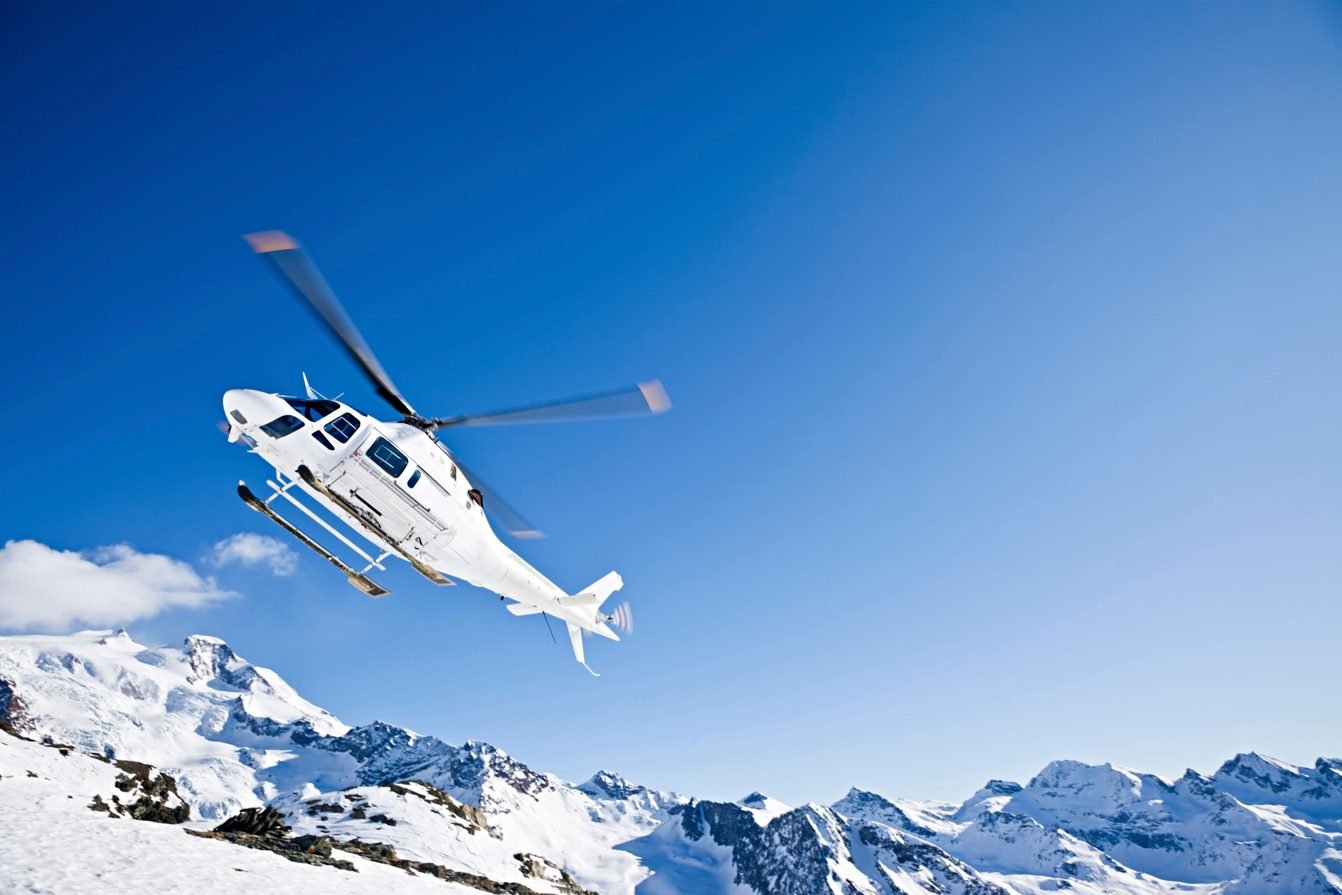
The global fleet — what flies where, and why
Four airframes cover most serious rotary work worldwide. Each was built around a different problem.
| Aircraft | Build and purpose | Range and terrain |
|---|---|---|
| Airbus ACH160 (twin, executive) | Composite airframe with Blue Edge blades, which curve at the tip to cut the slap you normally hear on approach. The cabin is acoustically lined. Built for boardroom transfers, premium tourism and diplomatic movement. | About 850 km. Coastal routes, city executive helipads, temperate plains. |
| Leonardo AW139 (intermediate twin) | Generous power margin, duplicated critical systems, seats up to fifteen. The workhorse of offshore crew rotation and large-scale rescue. | About 1,060 km. Open sea, tropical island chains, hot desert flats. |
| Bell 429 GlobalRanger (light twin) | Glass cockpit with a flat cabin floor, so the interior converts between stretcher configuration and VIP seating in minutes. | About 755 km. Dense city grids, plateaus, rolling country. |
| Sikorsky S-92 (heavy utility) | Certified to North Sea standards, with full anti-icing and a large internal volume. Used for military logistics, troop movement and deep offshore work. | About 1,000 km. Arctic shelves, rough ocean fronts, humid jungle. |
The practical takeaway: range figures on a spec sheet assume sea level and still air. In the Himalayas, thin air and afternoon winds cut usable range considerably. Any honest operator quoting a mountain route will plan well inside the published maximum, and that margin is worth asking about before you confirm any helicopter booking in India.
Owning a helicopter privately
Private ownership is less about the purchase price than about everything that follows it. Four requirements sit at the centre.
- Registration and clean title. The aircraft must be registered with the civil aviation authority under a company or an individual, with a Certificate of Registration issued and a title history free of liens or disputed transfers.
- Hangarage. You cannot park it at home, and that surprises first-time buyers more than anything else. Owners need permanent or leased hangar space at a licensed airport, or a registered private helipad with foam-based fire suppression and secured perimeter fencing.
- Crew and engineers. Expect to employ a chief pilot holding a valid Commercial Helicopter Pilot Licence with instrument ratings, plus certified airframe and powerplant engineers. This is a payroll commitment, not a per-flight arrangement.
- CAMO and airworthiness. Continuing Airworthiness Management Organisation protocols require a digital log of every flight hour, every component approaching its life limit, and every mandatory service bulletin from the manufacturer. Miss one directive and the aircraft is grounded.
This is why many people who could afford ownership choose private helicopter charter instead. The fixed annual cost of a lightly flown private aircraft frequently exceeds what the same hours would cost chartered. Run the sums over five years before committing: for most buyers flying under a hundred hours a year, private helicopter charter wins comfortably.
Running a commercial operation
Setting up as a commercial operator is a four-phase process, and none of the phases moves quickly.
- Incorporation and financial clearance. A company with the prescribed minimum paid-up capital, plus financial and background checks cleared by the relevant national security ministries.
- The Air Operator Certificate. The heaviest stage. Operations specifications, a Safety Management System, training manuals and full operational documentation go to the regulator, followed by proving flights. Most applicants underestimate this by several months.
- Aircraft acquisition. Importing or leasing commercial-category airframes configured for passenger carriage, with hull and liability cover in place before anything flies commercially.
- Routes and security clearance. Coordination with Air Traffic Control, defence agencies and state home ministries for approved corridors, night-operation pathways and access to restricted airspace. In border regions and around pilgrimage sites, this is the phase that decides whether a route is commercially viable at all.
Anyone offering helicopter charter services in India without a valid operator permit is operating illegally, whatever their website says. Ask for the certificate number. A legitimate operator will give it without hesitation, and the regulator publishes the list of current holders so you can check it yourself.
Charter and utility services
Rotary aviation covers far more ground than sightseeing. These are the categories in commercial demand today.
- Political and campaign movement. Multi-stop, high-frequency routing for candidates working rural constituencies on compressed rally schedules, where the nearest airstrip is often two hours away by road.
- Ceremonial flower showering. Low-altitude petal drops over weddings, temple consecrations, festivals and public events. Precision work: drop altitude and airspeed decide whether the petals land on the mandap or three fields away.
- Heli-skiing and alpine drops. High-altitude insertion flights placing skiers and safety equipment on untracked snowfields and remote glacial shoulders.
- Aerial filming. Gimbal-stabilised, vibration-damped camera mounts for feature films, live sports coverage and commercial shoots.
- Wedding and event transfers. Grand entries, guest shuttles between heritage properties, and resorts that roads serve poorly. Most couples book this as a straightforward private helicopter charter for a single afternoon.
- Air ambulance and EMS. Life-support-equipped aircraft for trauma evacuation, neonatal transfer and organ transport between remote incident sites and city hospitals. The golden hour is the entire argument for this category.
- Industrial survey and mapping. Slow-speed topographic work, high-tension powerline inspection and thermal imaging for engineers, mining operations and developers.
Filming and survey work needs permits arranged weeks ahead; an EMS call is dispatched in minutes. Corporate clients who fly the same sector repeatedly often move to a retained private helicopter charter arrangement, which fixes the hourly rate and secures aircraft availability.
Helicopter tours in India — the complete route list
This is where domestic demand concentrates. Helicopter tours in India fall into two broad families: Himalayan pilgrimage circuits, and scenic or heritage flying.
Himalayan pilgrimage circuits
- The full Char Dham circuit, four to six days. Flying out of regional hubs, principally Dehradun's Sahastradhara helipad, the route runs through Yamunotri, Gangotri, Kedarnath and Badrinath in turn, with ground transfers and darshan arrangements included. A Char Dham Yatra by helicopter compresses what is otherwise a gruelling ten-to-twelve-day road and trek journey into under a week, which is the whole reason it exists for older pilgrims. Seats open months ahead of the season and are usually gone within weeks.
- Do Dham and single-shrine flights. Shorter itineraries covering the two most-requested shrines, usually Kedarnath and Badrinath, or a single shrine as a day return. Kedarnath helicopter booking is the highest-volume product in this category by a wide margin: the alternative is a sixteen-kilometre uphill trek. The day-return shuttles from Phata, Sersi and Guptkashi get a pilgrim to the shrine and back before evening; those shuttle tickets are sold only through IRCTC, while Kedarnath packages from Dehradun are arranged as charters.
- Vaishno Devi ridge shuttles. Short shuttles between the Katra base and the Sanjichhat helipad, bypassing the crowded walking route.
- Amarnath. Weather-dependent operations from Neelgrath (Baltal, near Sonmarg) and Pahalgam to Panjtarni during the yatra window.
- Hemkund Sahib and the Valley of Flowers. Seasonal summer and monsoon windows carrying pilgrims, trekkers and botanists across glacial valleys and protected alpine meadows.
- Trans-border passes and Kailash Mansarovar connectors. Border-region charter routes through deep mountain defiles and high plateau gateways: clearance-heavy, weather-dependent, and not available at short notice.
- Regional hill yatras. Local shuttles such as Machail Mata in Kishtwar, flying narrow valley corridors during annual festival windows.
Scenic, coastal and heritage flying
Not every flight is a pilgrimage. A growing share of helicopter tours in India is purely recreational.
- City skyline loops. Short weekend joy rides from the major cities, with aerial views of skylines, bridges and coastline.
- Island and backwater sweeps. Low-altitude coastal runs over island chains, tidal estuaries and inland waterways, the southern backwaters and coastal resort corridors in particular.
- Desert fort and palace trails. Heritage routes over desert strongholds, royal palaces and landmarks best understood from above.
These scenic helicopter tours in India run on fixed seasonal schedules rather than on demand, so they are booked by the seat rather than chartered.
Planning your flight
A few things worth knowing before you enquire.
- Mountain sectors fly on weather, not on schedule. Kedarnath and Badrinath shut down for low cloud with little warning, and any operator promising a guaranteed slot in the monsoon is overselling. Build a spare day into pilgrimage plans.
- Weight matters more than passengers expect. High-altitude sectors impose strict per-person and baggage limits, and these are safety margins rather than commercial policy. Declare weights honestly when you book, particularly for Himalayan routes.
- Book pilgrimage sectors early. Char Dham and Amarnath seats open months ahead and fill in weeks. Weddings and filming can often be arranged within a fortnight; survey and industrial work usually takes longer because of permit lead times.
- Verify the operator. Permit number, insurance cover, aircraft registration. It takes one phone call, and it is the single most useful thing you can do before any helicopter booking in India goes ahead.
- Understand what the quote covers. Landing fees, helipad charges, ground transfers and crew night-halt costs are sometimes quoted separately. Ask for an all-inclusive figure; reputable helicopter charter services in India will give you one without argument.